
Stand mixers have evolved from luxury appliances to essential kitchen tools that every serious baker should consider. Whether you’re kneading bread dough, whipping cream, or mixing cookie batter, a quality stand mixer saves time, energy, and delivers consistently better results than hand mixing.
With modern kitchen design trends in 2025 emphasizing both functionality and aesthetics, today’s stand mixers aren’t just powerful workhorses—they’re statement pieces that complement your kitchen republic. From the iconic KitchenAid Artisan to budget-friendly alternatives, this comprehensive guide breaks down everything you need to know to choose the best stand mixer for your needs.
I’ve spent months testing the top stand mixers on the market, putting them through real-world baking challenges from delicate meringues to heavy bread dough. This pillar page covers all aspects of stand mixer selection, comparison, and usage to help you make an informed decision.
Table of Contents
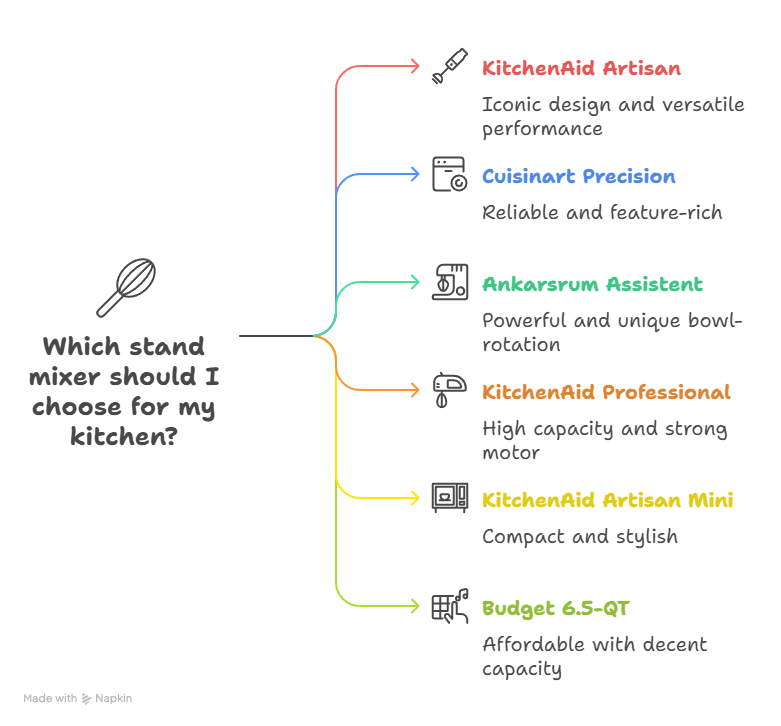
Quick Picks: Best Stand Mixers at a Glance
KitchenAid Artisan Series
The gold standard for home bakers. Durable metal construction, 10 speeds, and over 10 attachment options make this the kitchen master that lasts for generations.
View on AmazonCuisinart Precision Master
A powerful 500-watt motor with 12 speeds at a fraction of the KitchenAid price. Perfect for budget-conscious bakers who won’t compromise on quality.
View on AmazonAnkarsrum Assistent Original
With its unique rotating bowl design and 1500-watt motor, this Swedish powerhouse kneads dough like a professional bakery mixer.
View on AmazonKitchenAid Professional 600
A 6-quart bowl and bowl-lift design make this ideal for large families or serious batch baking. Built for heavy-duty use.
View on AmazonKitchenAid Artisan Mini
All the KitchenAid quality in a 20% smaller footprint. Perfect for small kitchens or occasional bakers who want premium performance.
View on AmazonLarge Capacity Stand Mixer
Large capacity, powerful 660-watt motor, and all essential attachments at an entry-level price. Great for beginners or big families.
View on AmazonWhat is a Stand Mixer?
A stand mixer is a countertop electric appliance designed to automate mixing, kneading, and whipping tasks that would otherwise require significant manual effort. Unlike handheld mixers, stand mixers feature a motorized head mounted on a sturdy base with a bowl that locks into position underneath.
How Stand Mixers Work
Most stand mixers use a planetary mixing action, where the beater rotates in one direction while simultaneously revolving around the bowl in the opposite direction. This ensures thorough ingredient incorporation by reaching all areas of the bowl—typically hitting 59 or more touchpoints per rotation.
The motorized design frees your hands to add ingredients, check recipes, or prepare other components of your dish while the mixer works. This hands-free operation is what distinguishes stand mixers from their handheld counterparts and makes them indispensable for serious bakers.
Why You Need a Stand Mixer
Time and Energy Savings
Hand-mixing bread dough for 10-15 minutes is exhausting. A stand mixer handles this effortlessly while you prepare other ingredients or clean up. Tasks that would take 20 minutes by hand are completed in 5 minutes with a stand mixer.
Consistent Results
Stand mixers maintain steady speed and power throughout the mixing process, ensuring even texture and proper gluten development in bread dough or perfect peaks in whipped cream. The planetary mixing action reaches every part of the bowl, eliminating unmixed pockets of flour or butter.
Versatility Beyond Mixing
Modern stand mixers aren’t just for baking. With optional attachments, they transform into:
- Pasta makers for fresh fettuccine and ravioli
- Meat grinders for homemade sausages
- Vegetable spiralizers for healthy noodle alternatives
- Food processors for slicing and shredding
- Ice cream makers for frozen desserts
- Grain mills for fresh flour
Professional-Quality Results at Home
Stand mixers deliver the same mixing power found in professional bakeries, enabling you to tackle recipes that would be impossible by hand—from authentic French macarons to artisan sourdough bread.
Key Features to Consider
Motor Power
Motor wattage determines what your mixer can handle:
- 250-350 watts: Suitable for light to medium tasks like cake batters, cookies, and light dough
- 400-550 watts: Handles most home baking including bread dough and thick batters
- 600+ watts: Professional-grade power for heavy doughs, large batches, and continuous use
Pro Tip
Don’t just focus on wattage—torque (rotational force) matters more for heavy doughs. Some lower-wattage mixers with better gearing outperform higher-wattage models.
Bowl Capacity
Choose based on your typical batch sizes:
- 3-4.5 quarts: Perfect for singles, couples, or small families. Makes 1-2 loaves of bread or 3-4 dozen cookies
- 5-6 quarts: The sweet spot for most households. Handles 4-5 loaves or up to 9 dozen cookies
- 7+ quarts: For large families, batch baking, or those who frequently entertain
Speed Settings
More speeds provide better control for different tasks. Look for at least 6 speeds, with 10-12 being ideal. Key speeds include:
- Low (1-2): Gentle stirring, incorporating dry ingredients without creating dust clouds
- Medium (3-6): Creaming butter and sugar, mixing batters
- High (7-10): Whipping cream, beating egg whites, fast kneading
Tilt-Head vs. Bowl-Lift Design
Tilt-Head Advantages
- Easier to add ingredients mid-mix
- Simpler to change attachments
- More compact design
- Generally less expensive
- Better for smaller batches
Bowl-Lift Advantages
- Handles heavier, larger batches
- More stable during heavy mixing
- Better motor cooling for continuous use
- Professional-style design
- Ideal for 6+ quart capacities
Construction Quality
Look for mixers with metal gears, not plastic, which can strip under heavy loads. All-metal construction lasts longer and handles stress better than ABS plastic housings, though it does add weight and cost.
Included Attachments
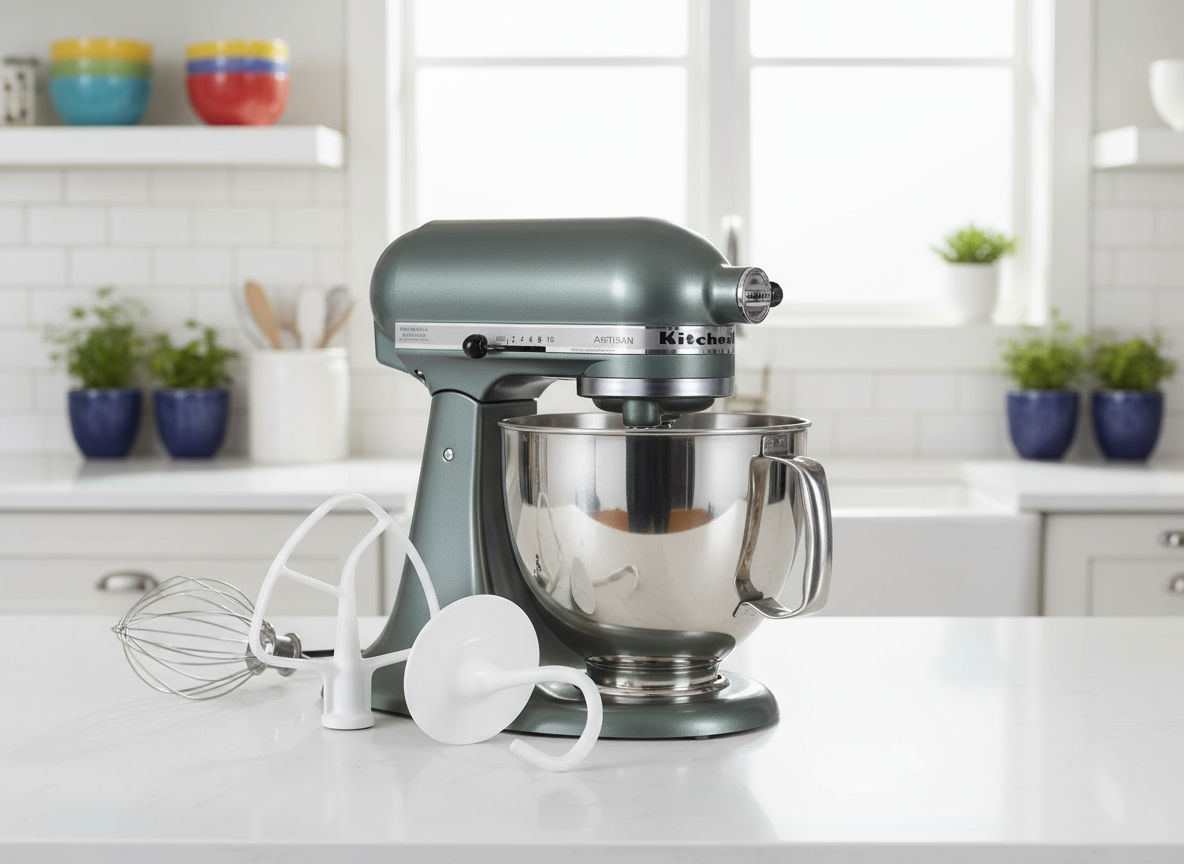
Standard attachments typically include:
- Flat beater: For general mixing of batters, cookies, and frostings
- Wire whip: For whipping cream, egg whites, and light batters
- Dough hook: For kneading bread dough and pizza dough
- Pouring shield: Prevents splashing and allows ingredient addition through a chute
Attachment Hub
If you plan to expand functionality, verify the mixer has an attachment hub that accepts additional accessories. KitchenAid’s hub is the most extensive with 15+ options, while some budget models don’t offer any expansion capability.
Types of Stand Mixers
Standard Planetary Mixers
The most common type, found in KitchenAid, Cuisinart, and most other brands. The beater spins on its axis while orbiting the bowl, ensuring complete coverage. Best for all-around home baking.
Bowl-Rotation Mixers
Exemplified by the Ankarsrum Assistent, these feature a stationary arm while the bowl rotates. This design excels at kneading bread dough with less heat buildup but requires more attention for batters to ensure complete mixing.
Compact/Mini Mixers
Scaled-down versions of full-size mixers, typically with 3-4 quart bowls. Perfect for small kitchens, apartments, or occasional bakers who don’t need commercial capacity.
Professional/Commercial Mixers
Heavy-duty models with 6-8 quart capacities, powerful motors (600+ watts), and bowl-lift designs. Built for daily use and large-batch production. More expensive but worth it for serious home bakers or side businesses.
Top Stand Mixer Models Reviewed
1. KitchenAid Artisan Series 5-Quart
Motor: 325W | Capacity: 5 Qt | Speeds: 10
The KitchenAid Artisan remains the most popular stand mixer in the world for good reason. Its timeless design, available in over 20 colors, makes it a kitchen showpiece, while the robust metal construction ensures decades of reliable service.
What Makes It Great
The 325-watt motor handles everything from delicate meringues to thick pizza dough. The 10-speed settings provide precise control, and the tilt-head design makes ingredient addition simple. The 5-quart stainless steel bowl with comfortable handle is dishwasher-safe and perfectly sized for most home baking needs—mixing up to 9 dozen cookies or 4 loaves of bread in a single batch.
The real game-changer is the attachment hub. With over 15 optional accessories available, this kitchen master transforms into a pasta maker, food processor, meat grinder, and more. It’s an investment in kitchen versatility that pays dividends for years.
Pros
- Durable all-metal construction
- 20+ color options to match any kitchen
- Extensive attachment ecosystem
- Proven reliability and longevity
- Excellent customer support and warranty
Cons
- Higher price point
- Heavy at 24 lbs
- Bowl capacity may be small for large families
- Can struggle with very small quantities
Best For: Serious home bakers who want a stand mixer that will last for decades and value the ability to expand functionality with attachments.
View on Amazon2. Cuisinart Precision Stand Mixer
Motor: 500W | Capacity: 5.5 Qt | Speeds: 12
The Cuisinart Precision represents exceptional value, offering more power and capacity than the KitchenAid Artisan at a significantly lower price. With a 500-watt motor and 12 speed settings, it actually outperforms the Artisan on paper.
What Makes It Great
The 5.5-quart bowl provides 10% more capacity than KitchenAid’s 5-quart offering, and the dual handles make lifting easier. The slow-start feature prevents ingredient clouds when you begin mixing flour or powdered sugar. The sturdy tilt-head design and included splash guard with pour spout make adding ingredients mess-free.
For bread bakers, the powerful motor and quality dough hook handle even stiff doughs without bogging down. The mixer performed admirably in testing across all categories, from whipping cream to kneading whole wheat bread.
Pros
- More powerful motor than KitchenAid
- Larger bowl capacity with dual handles
- 12 speeds for precise control
- Excellent value for money
- Slow-start prevents mess
Cons
- Ingredients can stick to bowl sides
- Louder at high speeds
- Fewer color options than KitchenAid
- Limited attachment ecosystem
- Shorter track record than KitchenAid
Best For: Budget-conscious bakers who want premium performance without the KitchenAid price tag, especially bread bakers who need power.
View on Amazon3. Ankarsrum Assistent Original
Motor: 1500W | Capacity: 7 Lt | Speeds: Variable
The Swedish-made Ankarsrum takes a completely different approach to mixing. Instead of the beater rotating around the bowl, the bowl itself rotates while the mixing tools remain stationary. This unique design excels at bread making and has developed a cult following among serious bakers.
What Makes It Great
The 1500-watt motor is the most powerful of any home stand mixer, capable of kneading large batches of dough with ease. The rotating bowl generates less heat than traditional mixers, producing better gluten development and superior bread texture. The 7-liter capacity handles enough dough for 5-6 loaves of bread.
Build quality is exceptional—all-metal construction with a timer and incredibly durable components designed to last a lifetime. The learning curve is steeper than conventional mixers, but once mastered, many bakers swear they’ll never go back.
Pros
- Unmatched bread-making capability
- Powerful 1500W motor
- Large 7-liter capacity
- Less heat generation during kneading
- Built to last generations
Cons
- High price point
- Steeper learning curve
- Requires more attention for cake batters
- Large footprint
- Limited attachments compared to KitchenAid
Best For: Dedicated bread bakers and artisan baking enthusiasts who prioritize dough quality over versatility and don’t mind the learning curve.
View on Amazon4. KitchenAid Professional 600 Series
Motor: 575W | Capacity: 6 Qt | Speeds: 10
For those who need more capacity and power than the Artisan, the Professional 600 steps up with a bowl-lift design, larger bowl, and stronger motor. This is the mixer for serious batch baking or large families.
What Makes It Great
The 575-watt motor provides nearly double the power of the Artisan, handling up to 14 cups of flour in a single batch. The bowl-lift mechanism is more stable than tilt-heads when dealing with heavy doughs or full bowls. The 6-quart capacity accommodates 13 dozen cookies or 8 loaves of bread.
Commercial-style construction means this mixer can handle daily use without strain. It’s the choice of many home baking businesses and prolific home bakers who regularly make large quantities.
Pros
- Powerful motor for heavy-duty use
- Large 6-quart capacity
- Stable bowl-lift design
- KitchenAid attachment compatibility
- Built for continuous use
Cons
- Expensive
- Very heavy at 29 lbs
- Bowl-lift less convenient for small batches
- Takes up significant counter space
- Overkill for occasional bakers
Best For: Large families, batch bakers, home baking businesses, or anyone who regularly makes multiple loaves of bread or massive quantities of cookies.
View on Amazon5. KitchenAid Artisan Mini
Motor: 250W | Capacity: 3.5 Qt | Speeds: 10
All the KitchenAid quality in a footprint that’s 20% smaller and 25% lighter than the full-size Artisan. Perfect for small kitchens, apartments, or bakers who don’t need commercial capacity.
What Makes It Great
Don’t let the compact size fool you—this mixer still delivers on quality. The 250-watt motor handles most baking tasks except the heaviest bread doughs. The 3.5-quart bowl is perfect for 1-2 people, making up to 5 dozen cookies or one loaf of bread at a time.
It maintains the same 10-speed control and attachment hub as its larger siblings, so you get full KitchenAid versatility in a space-saving package. The lighter weight makes it easier to move in and out of storage.
Pros
- Compact footprint for small kitchens
- Lighter and easier to move
- Full KitchenAid quality and warranty
- Attachment hub compatible
- Available in multiple colors
Cons
- Smaller capacity limits batch sizes
- Less powerful motor struggles with stiff doughs
- Not much cheaper than full-size Artisan
- Less stable during heavy mixing
Best For: Singles, couples, small-kitchen owners, or occasional bakers who want KitchenAid quality without the bulk.
View on Amazon6. Budget Large Capacity Stand Mixer
Motor: 660W | Capacity: 6.5 Qt | Speeds: 6 + Pulse
For those entering the world of stand mixers or needing large capacity on a tight budget, this 6.5-quart mixer offers surprising value. While it lacks brand recognition, the specifications are impressive for the price.
What Makes It Great
The 660-watt pure copper motor actually exceeds the power of the KitchenAid Professional 600. The massive 6.5-quart bowl with dual handles accommodates huge batches, perfect for big families or holiday baking. Despite the low price, it includes all essential attachments plus a splash guard.
The tilt-head design and LED power indicator provide basic functionality, and the quiet operation is a pleasant surprise at this price point.
Pros
- Extremely affordable
- Powerful motor for the price
- Large capacity for big batches
- Dual handles on bowl
- Complete attachment set included
Cons
- ABS plastic construction
- Unknown brand with limited support
- No attachment hub for expansion
- Fewer speeds than premium models
- Longevity unproven
Best For: Budget-conscious beginners, large families needing capacity without premium prices, or those uncertain about long-term stand mixer use.
View on AmazonSide-by-Side Comparison
| Model | Price Range | Motor | Capacity | Speeds | Design | Weight | Attachments | Best For |
|---|---|---|---|---|---|---|---|---|
| KitchenAid Artisan | Premium | 325W | 5 Qt | 10 | Tilt-Head | 24 lbs | 15+ options | Overall best |
| Cuisinart Precision | Mid-range | 500W | 5.5 Qt | 12 | Tilt-Head | 21 lbs | Limited | Best value |
| Ankarsrum | Premium Plus | 1500W | 7 L | Variable | Bowl-Rotate | 28 lbs | Some | Bread baking |
| KitchenAid Pro 600 | Premium | 575W | 6 Qt | 10 | Bowl-Lift | 29 lbs | 15+ options | Large capacity |
| KitchenAid Mini | Mid-range | 250W | 3.5 Qt | 10 | Tilt-Head | 17 lbs | 15+ options | Small kitchens |
| Budget 6.5-QT | Budget | 660W | 6.5 Qt | 6 + Pulse | Tilt-Head | N/A | None | Budget buyers |
Buying Guide by Need
For Bread Bakers
Prioritize motor power (500W+) and sturdy construction. The Ankarsrum Assistent is the gold standard for bread, but the Cuisinart Precision or KitchenAid Professional 600 also excel. Look for models with quality dough hooks and planetary mixing that won’t strain under heavy loads.
For Cake and Pastry Makers
The KitchenAid Artisan shines here with its precise speed control and wire whip attachment. The 5-quart capacity handles most cake recipes perfectly, and the tilt-head design makes scraping down sides easy.
For Small Kitchens
The KitchenAid Artisan Mini delivers quality performance in a compact package. Alternatively, consider storing a full-size mixer in a cabinet and bringing it out when needed—the versatility may be worth the storage shuffle.
For Large Families
Go big with the KitchenAid Professional 600 (6 Qt) or the budget-friendly 6.5-QT mixer. The larger capacity means fewer batches and more efficient baking for crowds.
For First-Time Buyers
Start with the Cuisinart Precision for excellent performance at a reasonable price, or the budget 6.5-QT mixer if you want to test the waters before investing in premium equipment.
For Future Expansion
If you plan to add pasta-making, food processing, or other capabilities, choose a KitchenAid model (Artisan, Mini, or Professional 600). The extensive attachment ecosystem is unmatched.
Budget Breakdown
Budget-Friendly: Large capacity mixers or wait for KitchenAid sales
Mid-Range: Cuisinart Precision, KitchenAid Artisan (on sale), or KitchenAid Mini
Premium: Full-price KitchenAid Artisan, KitchenAid Professional 600
Premium Plus: Ankarsrum Assistent, Kenwood Titanium Chef, high-end KitchenAid models
Care and Maintenance
Daily Cleaning
- Wipe down the mixer body with a damp cloth after each use
- Wash bowl and attachments in warm soapy water or dishwasher (if dishwasher-safe)
- Never submerge the mixer head in water
- Dry all components thoroughly before storage
Monthly Maintenance
- Check the beater-to-bowl clearance—it should just clear the bottom without scraping
- Inspect attachments for wear or damage
- Clean the attachment hub with a brush to remove flour buildup
- Wipe down the entire mixer, including hard-to-reach crevices
Long-Term Care
- Avoid running the mixer continuously for more than 15-20 minutes; let it rest to prevent motor overheating
- Don’t exceed the maximum capacity listed in your manual
- Use the correct attachment for each task
- Store in a dry location away from heat sources
- Keep the original box for moving or long-term storage
Troubleshooting Common Issues
Mixer walks across counter: Check that beater clearance is correct; ensure mixer is on a level, non-slip surface; reduce speed; don’t overfill bowl
Motor strains or stops: Reduce load; use lower speed for heavy doughs; allow motor to cool if overheated
Ingredients not fully mixed: Adjust beater-to-bowl clearance; scrape down sides manually; ensure bowl is properly locked in place
Frequently Asked Questions
Are stand mixers worth the investment?
Absolutely, if you bake regularly (weekly or more). Stand mixers save time, produce better results, and last for decades with proper care. The hands-free operation allows you to multitask while mixing. For occasional bakers (monthly or less), a handheld mixer may suffice.
Can stand mixers knead bread dough?
Yes, this is one of their primary functions. Models with 300W+ motors handle most bread doughs easily. For heavy or large batches, opt for 500W+ motors. Always use the dough hook attachment and follow the manufacturer’s capacity guidelines.
Do I need a specific mixer for gluten-free baking?
No special mixer is required. Gluten-free batters are often thinner and easier to mix than traditional recipes. Any standard stand mixer works perfectly fine for gluten-free baking.
How long do stand mixers last?
Quality mixers like KitchenAid typically last 15-30+ years with normal home use. Many bakers inherit mixers from previous generations. Budget models may last 5-10 years. Regular maintenance and avoiding overload extend lifespan significantly.
What’s the difference between wattage and torque?
Wattage measures electrical power consumption, while torque measures rotational force. For stand mixers, torque matters more for heavy doughs. Some lower-wattage mixers with superior gearing generate more torque than higher-wattage competitors.
Can I use my stand mixer for small batches?
It depends on the model. Large 6+ quart mixers struggle with tiny quantities (single egg white, for example). The 3.5-5 quart range handles small to large batches most effectively.
Are KitchenAid attachments worth it?
If you’ll use them regularly, yes. The pasta roller, food grinder, and spiralizer attachments are high quality and save counter space compared to separate appliances. However, they’re expensive, so buy only attachments you’ll actually use weekly or monthly.
Should I buy a refurbished mixer?
Factory-refurbished models from reputable sellers can offer significant savings (30-50% off) with warranties. Avoid third-party refurbs without warranties. Always check what’s included—some refurbs lack accessories or have cosmetic imperfections.
Final Recommendations
After extensive testing and research, the KitchenAid Artisan Series remains the best all-around choice for most home bakers. Its combination of durability, performance, expandability, and style justifies the premium price for anyone who bakes regularly.
For value seekers who don’t need the KitchenAid ecosystem, the Cuisinart Precision delivers exceptional performance at a fraction of the cost. Its powerful motor and larger bowl make it ideal for practical bakers who prioritize function over form.
Bread baking enthusiasts should seriously consider the Ankarsrum Assistent. While expensive and unconventional, its unique design produces superior bread texture that’s immediately noticeable to anyone serious about artisan baking.
Budget-conscious buyers or those new to stand mixers can confidently start with the 6.5-QT budget mixer to learn if stand mixing suits their kitchen workflow before upgrading to premium equipment.
Ready to Transform Your Baking?
Choose your perfect stand mixer from the options above and experience the difference in your kitchen. Your future self will thank you for the investment in quality kitchen equipment that makes baking easier, faster, and more enjoyable.
See table below of top 3 best sellers for current pricing and detailed specifications.
Shopping Tips for Best Deals
- Watch for sales around Black Friday, Cyber Monday, and Amazon Prime Day for significant discounts
- KitchenAid often runs promotions with free attachments or reduced prices
- Check manufacturer websites for refurbished models at significant savings
- Wedding registries get completion discounts at most retailers
- Major retailers frequently run promotional coupons that work on stand mixers


